StatCounter


Nov 5, 2005

Lizzie Bright and the Buckminster Boy, Gary Schmidt

Book Find this book in the Hawley Library


From the description of this book, I didn’t really think I was going to like it. I read it because it got some literary awards. So once again, I should say that I learned my lesson not to judge a book by its (back) cover. Though of course, I haven’t really learned that lesson yet.

So the story is set back in the day in a rural Maine community. Turner, son of a preacher man, is the main character. He’s just moved from Boston, where people are more liberal and there are more people in general so he doesn’t feel so much like the entire town is watching him to make sure he never slips up. (Of course he does, and there are some side plots about that.) Lizzie is his friend, a really good friend (but not a special friend, at least it doesn’t seem like it goes that far.) but she is black, a member of a community founded by ex-slaves. Some of the townspeople hate having the black people there, and convince Turner’s dad to help oust them.

Things happen – houses burn, people die – you know. What I most recommend this book on is its solid writing, believable and deep characters, and fluid plot-line. Really good.

Oct 2, 2005

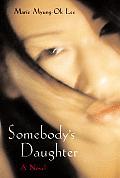
Somebody's Daughter, Marie Myung Ok Lee


I read this book mostly because it has personal appeal to me: it is about a girl who is Korean but adopted to a white family in America. My sister is Korean and grew up here with us, her totally white family. The plot centers around when she is about 18, goes off to college but ends up leaving school (much to her adoptive parents horror) and going to Korea to try to figure out who she is.

I’m having a hard time saying whether I liked this book or not because I had so many personal expectations going in. And this girl’s story and my sister’s just don’t overlap very much at all, so the book didn’t meet my expectations.

Anyway, the girl in the story, Sarah Thorson, goes to Korea and enrolls in a school to learn Korean. Although she appears Korean, she really is pretty much an outsider there because she can’t speak the language at all and doesn’t understand the first thing about the culture. Her white family had told her her parents had died in a car crash, which she finds out was a total lie – she was found abandoned at a fire station and no one has any idea who her parents are.

The book switches back and forth between Sarah’s story and the story of her birth mother. So we as readers know who she is and what her life was like. The book is interesting in that it takes a good look at a portion of the US population that seems under-represented (from my biased point of view) – there are so many Korean adoptees in our country. On the other hand, the story is so specific that it is hard to take a larger lesson. The author does hit on one point that seems more universal, at least from conversations with my sister and some other Korean adoptees we’ve known: it is bizarre to walk around looking Korean on the outside, but being acculturated as white because of who you grow up with and the larger environment. Especially then when you go out into the world as an adult and people don’t know your family so they don’t know you didn’t grow up within a certain culture. When my sister went to college, other Asian students were trying to talk with her about certain cultural things and she had to explain herself. The book does a good job explaining that aspect of being adopted.

Sep 18, 2005

Flying Leap, Judy Budnitz


This book was recommended to me by one of the other bloggers on here - ray.

I had been reading a string of fairly boring and totally not recommendable books, thus the lack of posts for a while, and this one finally broke that god-awful streak.

I love short stories, which this is a collection of. I love them 'cuz they cut to the chase, they mix it up, they are a bit raw - there's no time or space for slowly getting the reader acclimated to a character or a situation, it's sink or swim.

And what I love about this particular collection of short stories is that the author makes use of a style you see often with south and central american authors but not so much elsewhere. Fantastical realism. This is not to say fantasy, not at all. It's just that things happen that don't really happen in real life to sort of push people and expose their emotions and who they are through how they react. Like in the second story, the character's mother is dying and his aunts pressure him to donate his heart. The doctor pressures him, too, as does his girlfriend. And through that action we see what kind of crazy things people think and do.

I don't think I'm explaining this particularly well, which is sad because I really really loved most of these stories (I think some at the end of the book are a little dull). In fact, that story I was referring to earlier I actually recognized - it had been read on my all time favorite radio program ever - This American Life. (It's episode 256, Living Without, in case you want to hear it.)

Sep 8, 2005

Summer Reading Books Clubs - easy extra credit!

The dates and times for the summer reading 'book clubs' have been announced. Attend one and receive a homework/extra credit pass. Meet in the library.

September 12, 6:30-7:30pm
Please talk to the librarians if you plan on attending this evening discussion.

September 20, 2:30 - 3:30pm

Sickened

Born Confused

Lullaby

Boy Meets Boy

Crank

September 21, 2:30 - 3:30pm

The curious incident of the dog in the night-time

Eragon

Vampire High

First Meetings in the Ender's Universe

The House of the Scorpion

Pirates

The DaVinci Code

Ask in the library if you have any questions!

Jul 11, 2005

When I Was a Soldier: a memoir, Valerie Zenatti

soldier Find this book in the Hawley Library

First, a confession: I don’t know anything about history starting immediately following World War II. Especially international history. It seems all my history classes never managed to get past WWII, thus never learning about Vietnam, the Korean War, etc. It also means I never officially learned anything about the establishment of Israel and the who what why and where of why everyone in the Middle East hates us and why people are willing to blow themselves up over the whole thing.

This used to not matter to me. But now I care a great deal about why people blow themselves up and how that affects our lives – because it does, and it directly relates to why terrorists hate us so much.

So when I read a little review of this book I went out of my way to find it. This is the non-fiction account of Valerie Zenatti’s two years of mandatory service in the Israeli army, written from her teen perspective, making is very readable and clear and understandable. And enjoyable!

In Israel, everyone, both girls and boys, are required to serve in the military starting at age 18. Girls serve two years, boys serve three. Valerie not only shares the nitty gritty details of what this is like--to know your whole life you are going to serve in the potentially deadly military when you are still very young, and the details of her military service—but also what it is like to live in the country of Isreal, and how many people have such mixed feelings about the whole thing. Valerie is able to convey the many sides of the confusing issues for Israel and Palestine, without being confusing. I know it’s not a history book (which is why I liked it so much), so that the views are not unbiased, and that it is very partial and really only a starting point of understanding that conflict. But I definitely learned a lot.

It’s a fairly short book, and also in it Valerie is also typical teenager with friends and loves and complicated and simple relationships, just wanting to have some fun, just trying to figure out her place in the world. She is smart and witty, and has written a good book that spoke to me – not over my head, but not speaking down to me, either.

Jun 30, 2005

Vanishing Acts, Jodi Picoult

vanishingacts

This is the latest from Jodi Picoult, and it is pretty much what we’ve come to expect from this author. A little bit of a mystery, a bit of romance, a court room crime drama situation that manages not to derail the book, and so on. I really like her stuff, but I’ll have to be honest, this one comes apart at the seams a bit. They are all good page-turning beach reads, but some of Picoult’s books are definitely better than others.

Our main girl Delia is a semi-single mom (maybe in her late 20s?) whose relationship with her baby-daddy, Eric, has been rocky because of his alcoholism. She has a very close relationship with her own father, who solely raised her because her mom died when she was very young, or so she’s been told. Turns out, her mom is not dead, her dad kidnapped her from Arizona when she was really young, changed their names, moved them to New Hampshire, and has been living the suburban life of a fugitive ever since. He did this, he insists, because her mother was a terrible mother, being an extreme alcoholic.

So Delia’s father is arrested, she is having a real true identity crisis, Eric is a lawyer so he’s trying to represent Delia’s dad, Delia meets her mom, this other best friend of theirs is actually in love with Delia and gets all up in the mess, Delia has an experience with this Native American spiritualist, and on and on. I could list about fifty more plot elements without giving anything away, and therein lies my point: there is just too much thrown in here for a cohesive novel to emerge. It’s an ok book, but most of her other books are way better, especially My Sister’s Keeper.

Jun 16, 2005

I read the Bourne Identity, by Robert Ludlum. This is a thriller about a man named Jason Bourne who is found washed up on a beach with no memory. He has no idea who he is and his only clue is a microfilm implanted in his hip. Little does he know, this microfilm will lead him to a bank in Zurich, where he will start on a race for his life against unknown forces, the whole time trying to piece together his fragmented past. He is told by one source that he is one of the most feared assassins in the world, only topped by the mysterious assassin Carlos. Bourne is actually a trap for Carlos, a tool being used by the US government. He meets a woman named Marie St. Jacques, who tries to convince him he's not an assassin, and she eventually succeeds, but that's for the sequel.

I recommend this book to people who are not looking for a quick read. Sometimes the details used make it a slow read, but it's exciting and worth the time investment. You also have to like action and thrills if you read this book. Just in case you can't put it down, make sure you have some time on your hands.

Jun 8, 2005

Your personal favorites

Image hosted by Photobucket.com

Yet again, I must start a post in bibliotalk with "I don't know if this is allowed".

I think that one can learn a lot about one's taste in books by reading reviews, but even more by reading a list of a blogger's personal favorite books. I'm sure that we have all filled out the 'books' section in our blogger.com profiles, so why not simply copy and paste our selections into comments on this entry? Reading through these lists may give us all some background information on the reviewer's taste in literature. This might be helpful while considering reviews on bibliotalk, don't you agree? I'll start:

Cut, Wasted: The Memoir of an Anorexic and Bulimic, The Great Gatsby, Of Mice and Men, Stargirl, The Picture of Dorian Gray, Dangerous Angels: The Weetzie Bat Books, Violet and Claire, The Belljar, The Feed, Burgerwuss, Thirsty, Branded: The Buying and Selling of Teens, Born Confused, Hard Love, The Gospel Acording to Larry, Jinx, Buddhism Without Beliefs, Born Confused, the Gossip Girl books, the Harry Potter books, A Chamber of Horrors, Wuthering Heights, Romeo and Juliet, This Lullaby, Elvis by the Presleys, Taming of the Shrew, Modern Feminisms

Jun 7, 2005

The Burn Journals, Brent Runyon

burn

Wow. This is a totally amazing book. I kept having to remind myself that Runyon didn’t write this weeks after all this happened but years, because the way he puts everything down, the language he uses and the tense and everything just make it all feel so real and immediate. Of course it is real, but sometimes when you are reading non-fiction and there is dialogue, or there are parts where the author is telling what they were thinking at the time, it is so unbelievable. And you know the author just forgot what it felt like, or what somebody said, and just had to make it up to fill in the blanks. Not this book. Maybe Runyon did have to do that, but you never get that feeling at all. Everything he is thinking, the thoughts he has about why he set himself on fire and what he was like before and after, it’s just so authentic, not cheesy or moralistic or anything. It just really amazes me that he was able to get back into his fifteen-year-old brain and think in that same way again. Really well done. I wish this guy would write more YA, because he definitely has a great style for it, but he hasn’t written anything else at all.

Jun 5, 2005

A Mango-Shaped Space, Wendy Mass

Find this book in the Hawley Library

mango

I just really love this book. Normally I am extraordinarily critical, and pick apart this and that. This is not to say this is a life-altering, amazingly perfect book. But there is a sweet and gentle story, wrapped up in some real stuff that’s not overly dramatized.

Mia has synesthia – a condition where she sees colors in association with words, numbers, sounds, etc. In third grade she is called a freak and she understands no one else can see colors, so she hides it from her family and friends until her problems at school become overwhelming and she happens to meet a kid who appears to have the same deal she does. In other story lines, her grandpa has just died and she sort of transfers her grief into love of a new cat, the Mango of the title.

I don’t really want to give more away, just say that her condition is real, not many people at all have it but it is really interesting. Wendy Mass does a good job creating a story around it, with real and lovable characters.